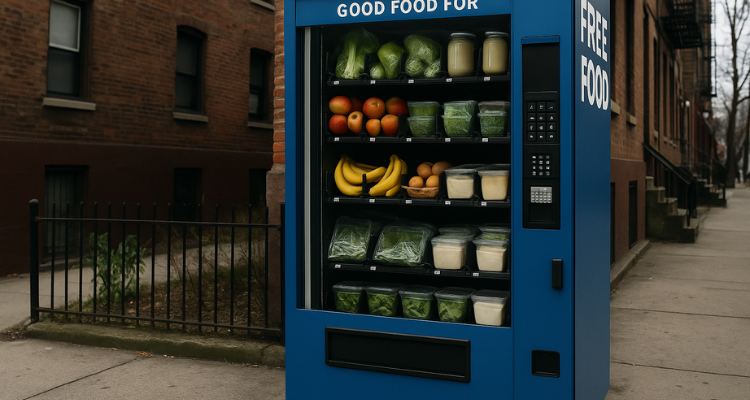
New York City has launched a new food-access initiative designed to support households facing economic hardship. The program introduces free vending machines stocked with healthy foods, available without cards, codes, or any type of formal application. The first machine has been installed in the Bronx, one of the city’s neighborhoods with the highest poverty rates.
The machines offer items such as fruits, vegetables, tea, and proteins, all at no cost to users. The purpose is to replace typical vending options like sugary drinks or snacks with healthier alternatives for families who struggle to afford nutritious food. The process is simple: open the machine and take what you need — no paperwork, no interviews, no waiting periods.
The Bronx faces longstanding economic challenges, with nearly one in four households living below the poverty line. Because of this, the first free vending machine was placed at the Kips Bay Boys & Girls Club. So far, it has distributed more than 7,000 kg of food to over 1,100 families.
Although this initiative does not replace the Supplemental Nutrition Assistance Program (SNAP), it offers a complementary approach to food access:
Both options serve low-income households, but the vending machine provides immediate, barrier-free access to nutritious foods within walking distance of home.
Most of the food is grown by local youth farmers using hydroponic gardens, a method that produces more food in less space and time. This approach brings multiple benefits:
There are plans to expand the initiative by installing additional machines in hospitals, schools, transit stations and community centers throughout New York City and eventually in more cities across the United States.
The initiative is led by Change Food For Good, a New York–based nonprofit focused on expanding access to healthy foods. The vending machines are part of its Good Food For All program, which aims to remove the traditional barriers that often accompany food assistance programs.
Each machine is restocked once or twice per month. Users can also scan a QR code to request items they would like to see added in future restocks — suggestions that have already shaped the inventory. Cream cheese, for example, was added after repeated community requests.
With this new model, New York is exploring innovative ways to ensure that vulnerable households can obtain nutritious food easily and without administrative hurdles.