
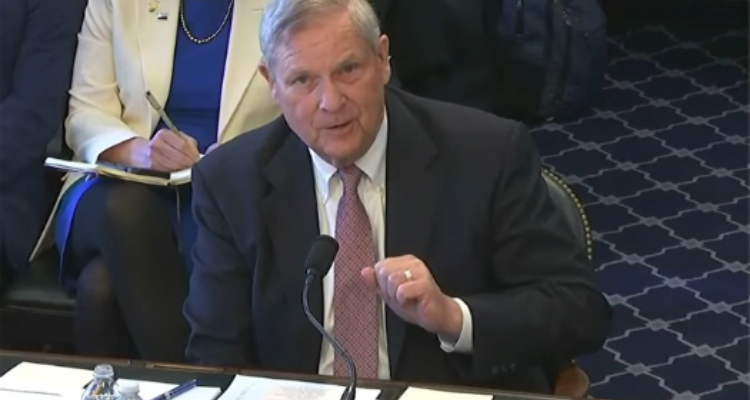
Agriculture Secretary Tom Vilsack appeared March 21, before the House Appropriations Subcommittee on Agriculture, Rural Development, and Food and Drug Administration to discuss USDA's FY 2025 budget request. During the hearing, subcommittee members addressed several issues, including the Supplemental Nutrition Assistance Program (SNAP), the Special Supplemental Nutrition Assistance Program for Women, Infants, and Children (WIC), employment of H-2A workers, and use of the Commodity Credit Corporation (CCC).
Subcommittee Chairman Andy Harris, R-Maryland, questioned Vilsack about USDA's refusal to approve SNAP pilot projects proposed by state and local governments that seek to restrict the purchase of sweetened beverages and other targeted foods. Vilsack explained that, while it has the authority to authorize such pilot tests, the proposals submitted so far lack adequate evaluations.
Harris also raised concerns about rising obesity rates during Vilsack's tenure as secretary and questioned the effectiveness of SNAP's food education programs in addressing this problem. In addition, she highlighted differences between SNAP and WIC regulations, suggesting that a WIC-like approach could be beneficial at the national level. Vilsack noted the complexity of implementing a uniform model across the country and discussed the need for equity in the distribution of emergency funds among farmers.
Rep. Rosa DeLauro, D-Connecticut, expressed concern about Vilsack's suggestion to establish a "food police office" for federal grant recipients with obesity problems. At the end of the hearing, Harris expressed interest in seeing SNAP demonstration projects in the future.
During the session, Andy Harris, R-Maryland, raised questions about the administration's request for an increase of approximately $7 billion for the WIC program, expressing concern about the accusations Republicans face as they seek to debate the WIC budget. In addition, Harris noted that the administration justifies this increase by anticipating an increase in participation and food prices, although she pointed out that the increase in WIC participation has been minimal and that the White House indicates that food inflation is declining.
On the one hand, Agriculture Secretary Tom Vilsack explained that the budget request for WIC also includes funds to restore other nutrition programs whose budgets were affected due to uncertainty over funding. On the other hand, Rep. Rosa DeLauro, D-Connecticut, expressed interest in budget proposals that provide contingency funds for WIC and asked Vilsack about sole source contracts with infant formula suppliers for the WIC program.